How to Plan Glass and Bottle Collection Rounds for Hospitality Sites
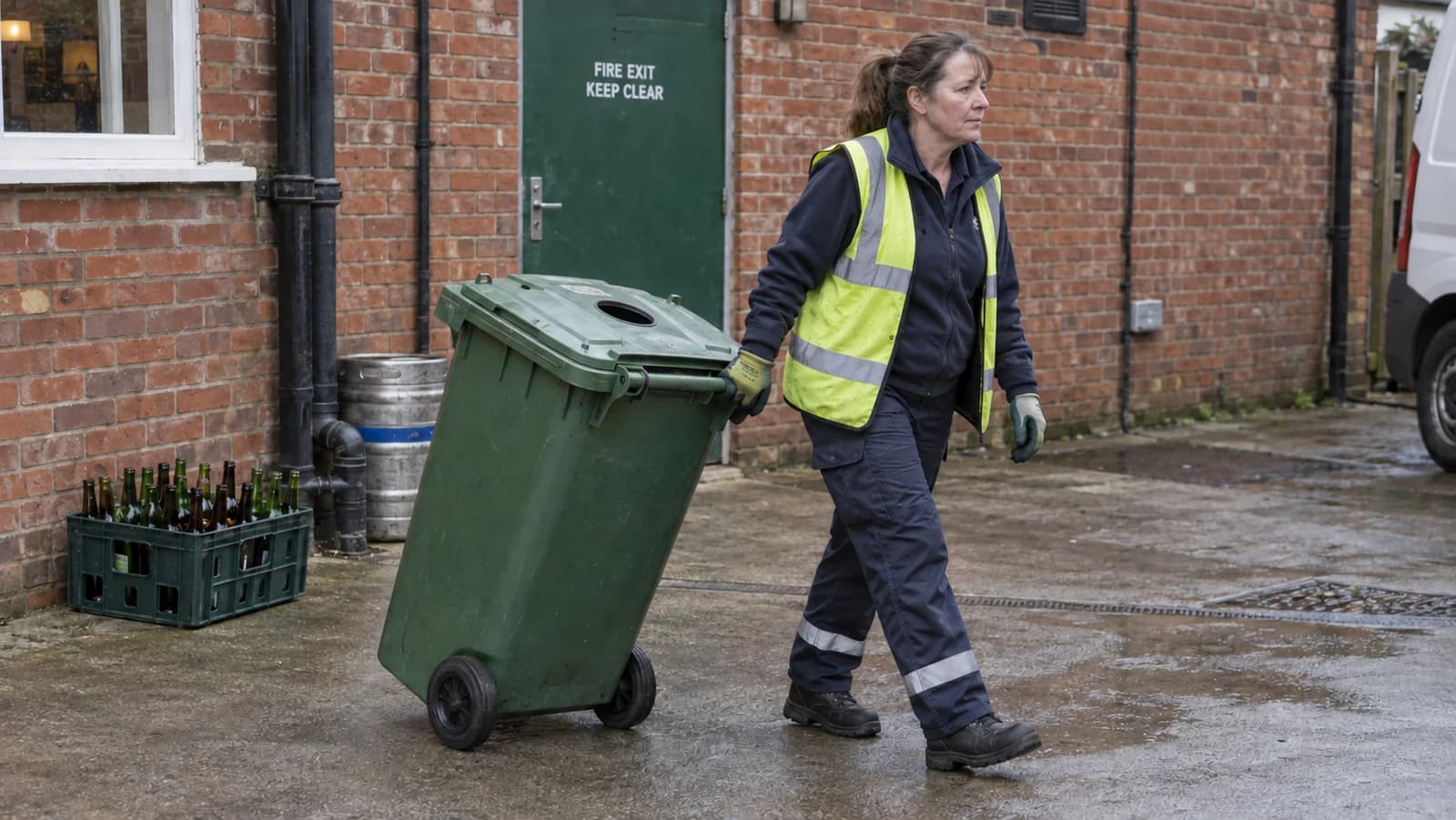
Pubs, restaurants, hotels and event venues produce glass in a pattern that is regular enough to plan but variable enough to cause trouble. A quiet Tuesday may barely fill a bin; a bank-holiday weekend can leave the same site overflowing before Monday morning. Glass is heavy, awkward to compact and often stored in tight yards, cellars or service alleys with strict access windows.
Good glass collection route planning therefore needs more than a postcode sequence. It needs a service profile for each customer, a realistic capacity model and a process for recording contamination, blocked access and unexpected volume.
This article focuses on the daily operation of commercial glass and bottle rounds. It is not a statement of what every business must separate in every UK nation; recycling rules and regulator guidance differ, so collectors and customers should check the requirements that apply to their locations.
Understand the rule backdrop without designing the route around assumptions
In England, Simpler Recycling workplace guidance includes glass bottles and rinsed food jars within dry recyclable materials. The rules have applied to most workplaces since 31 March 2025, while micro-firms with fewer than 10 full-time-equivalent employees have until 31 March 2027. Waste collectors must keep the required recyclable streams separate from non-recyclable waste; the official guidance explains when certain dry materials may be co-collected.
Wales has different separation requirements. Natural Resources Wales' workplace recycling guidance says workplaces must separate glass and that collectors and processors must collect it separately and keep it separated. Scotland and Northern Ireland have their own frameworks.
The practical lesson is to record the collection model at customer and depot level. Do not promise the same mixed-recycling arrangement across the UK without checking the applicable rule, the reprocessor's acceptance specification and any written co-collection assessment that may be needed.
Give every hospitality site a service profile
A customer name and address are not enough to plan a dependable collection. Build a profile that a relief driver can follow without local knowledge.
Include:
- business type and trading pattern;
- normal and peak-season collection frequency;
- container type, count and nominal capacity;
- accepted colours or mixed-glass arrangement;
- permitted materials and common contaminants;
- collection point, access route and safe stopping position;
- gate, key, code or concierge procedure;
- earliest and latest service times;
- noise-sensitive neighbours or restrictions;
- stairs, cellar lifts, cobbles or manual-handling constraints;
- contact and escalation details; and
- recent lift history, exceptions and estimated volume.
Photographs of the collection point can help, provided they are current, necessary and stored appropriately. A picture of the front door is less useful than a clear instruction such as "enter from service lane, stop inside marked bay, glass bin behind left-hand gate".
The glass and bottle collection software page shows how recurring schedules, site instructions and completed-job records can be brought together for this type of round.
Forecast demand from trading patterns, not calendar habit
Fixed weekly collection works for stable sites, but hospitality demand is affected by weather, events, holidays, football fixtures, weddings and tourist seasons. A route plan should use history without treating last week's lift as a guarantee.
Start with three measures for each site:
- Typical volume: the normal number of containers or estimated quantity collected.
- Peak factor: the uplift seen after known busy periods.
- Service tolerance: how much spare capacity remains before the customer risks overflow.
If a venue normally presents two 240-litre bins but needs four after a bank holiday, record that pattern and schedule capacity before the complaint arrives. For irregular venues, a confirmation cut-off can help: the customer reports expected demand by a set time, and the office approves any extra lift before routes are released.
Avoid false precision. Container fill percentage is an estimate unless you have a reliable measuring method. Use it to make planning decisions, then reconcile it with actual lifts or weights.
Plan around weight, lifts and service time
Glass rounds often reach a payload or safe-handling constraint before they run out of geographical stops. The plan should consider at least three capacities:
- vehicle payload and compartment limits;
- the number and type of containers that can be carried or exchanged; and
- the working time needed for each lift.
A basic route estimate can be expressed as:
planned demand = expected glass quantity + peak allowance + unplanned uplift buffer
Do not load to a theoretical maximum that leaves no room for variation. Confirm vehicle limits and loading arrangements through the operator's transport and safety processes.
Service time also varies. A wheeled bin beside a loading bay is different from boxed glass carried from a basement. Record actual arrival-to-departure time by site, then use a sensible rolling average. This exposes customers whose access arrangement—not geography—is making the route late.
Zone the round, then sequence the constrained stops
Build stable geographic zones so drivers learn sites and customers see predictable service days. Within each zone, sequence the difficult stops first:
- sites with short access windows;
- locations affected by loading restrictions;
- hotels that need collections before guest arrivals;
- pubs where late-morning service would disrupt preparation;
- venues with known event clear-down deadlines; and
- sites where a full vehicle cannot safely wait or turn.
Fit flexible customers around those anchors. Include the trip to the authorised receiving or bulking site as part of the route, with realistic time for queuing and unloading.
PaperRoute's route-planning tools support recurring schedules, stop sequencing and truck-aware navigation. They do not know whether a particular cellar is safe to access or whether a noise condition applies; those site-specific controls must be supplied and reviewed by the operator.
For more on reducing dead mileage without creating an unworkable schedule, read our waste collection route optimisation guide.
Make the driver's workflow short and unambiguous
At each site, the crew should be able to record the outcome quickly:
- Confirm the correct collection point and container.
- Check for obvious contamination or unsafe presentation.
- Record containers, estimated quantity or measured weight as required.
- Note damaged containers, access issues or additional material.
- Capture proportionate job evidence when it adds value.
- Complete the required transfer or movement record.
- Mark the stop complete, partial, rejected or inaccessible.
A long free-text note for every stop will not produce consistent data. Use a compact set of exception reasons, with a short explanation only when needed. Typical examples include contaminated glass, wrong materials, overfilled container, locked access, unsafe lifting conditions, container missing and extra lift not authorised.
The offline driver app can hold route and site details, record photographs and complete job data without a mobile connection. This is useful in cellars, service corridors and rural venues where signal is unreliable. The office still needs a clear policy on what evidence drivers should collect and how customer or worker data is handled.
Control contamination without turning every stop into an argument
Hospitality glass can be rejected or downgraded when it includes ceramics, drinking glasses, mirrors, heat-resistant cookware, bags of mixed rubbish or excessive liquid. Acceptance standards depend on the collector and reprocessor, so give the customer a service-specific list rather than a generic recycling poster.
Use a graduated process:
- minor first issue: collect if permitted, record and educate;
- repeat issue: provide evidence and a clear corrective action;
- materially non-conforming load: follow the agreed rejection or alternative-service process; and
- persistent contamination: review container placement, staff training, service terms and price.
Record what was found, not a vague label such as "bad bin". A photograph may help resolve a dispute, but only if it is linked to the correct customer, date and container.
Keep the collection record joined to the transfer
For non-hazardous business waste, GOV.UK's waste transfer note guidance requires a WTN or equivalent document with the required information for each transfer. A season ticket may cover repeated transfers when the relevant holder, carrier and waste type stay the same, supported by a schedule of individual movements.
For a glass round, link:
- customer and collection-site reference;
- date, time and collected quantity;
- waste description and classification;
- carrier and vehicle/load reference;
- applicable WTN or season-ticket schedule; and
- receiving-site or weighbridge record.
This does more than satisfy paperwork. It helps reconcile what drivers collected, what customers were billed for and what the destination received. For more on preparing your waste transfer processes for upcoming regulatory changes, see our digital waste tracking 2026 guide.
Review a small set of route measures
Useful weekly measures include:
- planned versus completed lifts;
- excess or unused vehicle capacity;
- travel time, service time and receiving-site waiting time;
- extra collections by customer and cause;
- contamination and rejection rate;
- repeated access failure;
- container damage or loss; and
- complaints about missed service, noise or overflow.
Separate a planning error from a demand change. A route that failed because a venue doubled its volume needs a different response from one that failed because the planner ignored a two-hour access window.
A practical setup sequence
For a new hospitality glass contract:
- Survey each collection point and confirm the accepted material.
- Record container, access, noise and service-window constraints.
- Obtain recent volume history where available.
- Choose a base frequency and document peak adjustments.
- Model the route against payload, lifts, service time and unloading.
- Give drivers a short exception and evidence process.
- Join each lift to the appropriate transfer record.
- Review actual time and quantity after the first two rounds.
- Correct service profiles before optimising the sequence again.
- Revisit peak factors before known seasonal demand.
Well-planned bottle collection rounds feel uneventful: venues know when the vehicle will arrive, crews can access the containers, payload remains manageable and exceptions reach the office before they become missed-service complaints. The route becomes reliable when customer demand, vehicle capacity and site reality are planned together—not when the postcodes merely look tidy on a map.